Comparative Analysis of RNN, GRU, and LSTM for Airline Passenger Time Series Forecasting
Hojung Lim · MASC 520 – Project 3 · USC Spring 2026
Overview
Method
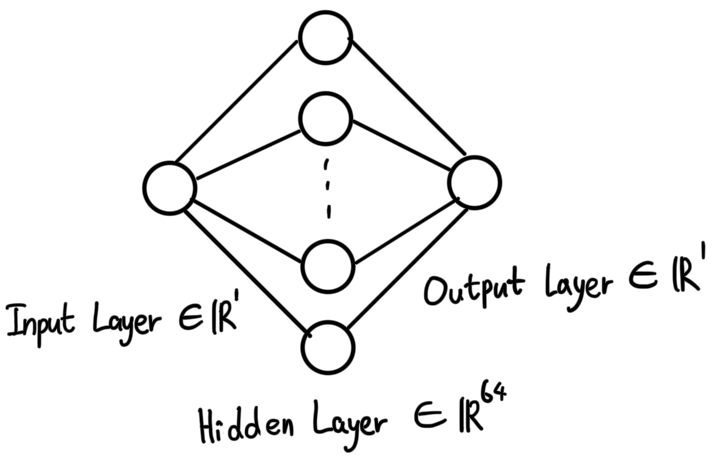
Figure 1: Shared recurrent network architecture — 64 hidden units, dropout, FC output
All three models share the same structure: a recurrent layer with 64 hidden units, a dropout layer (rate=0.0), and a fully connected output layer producing a single scalar. The vanilla RNN uses tanh activation; GRU and LSTM use gating mechanisms.
Dataset: 144 monthly passenger counts normalized to [0,1] with min-max scaling. Sliding window of length 12 (matching the seasonal period) creates input-output pairs. 80/20 temporal split: 105 training sequences, 27 validation sequences.
Training Configurations
| Hyperparameter | Test 1 (Baseline) | Test 2 (Improved) |
|---|---|---|
| Epochs | 150 | 300 |
| Learning Rate | 0.001 | 0.005 |
| Batch Size | 16 | 16 |
| Optimizer | Adam | Adam |
| LR Scheduler | None | Plateau-based adaptive |
| Best-Model Checkpointing | No | Yes |
| Gradient Clipping | Max norm 1.0 | Max norm 1.0 |
Results
Loss Curves — Test 1 (Baseline)
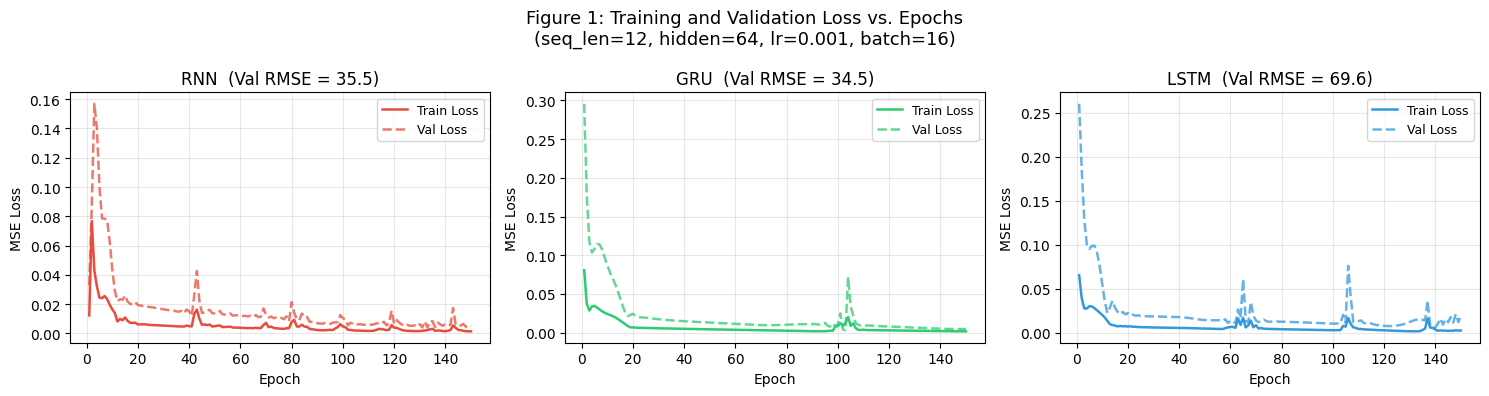
Figure 2A: Training and Validation Loss Curves — RNN, GRU, LSTM (Test 1, seq_len=12, hidden=64, lr=0.001)
Loss Curves — Test 2 (Improved)
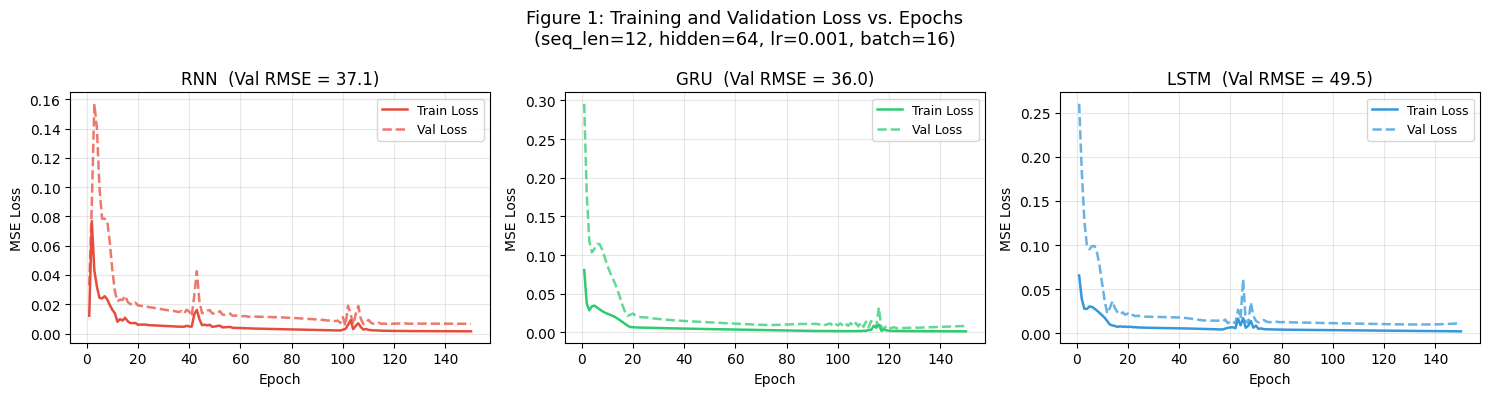
Figure 2B: Training and Validation Loss Curves — RNN, GRU, LSTM (Test 2, seq_len=12, hidden=64, lr=0.001)
Predictions vs. Actual
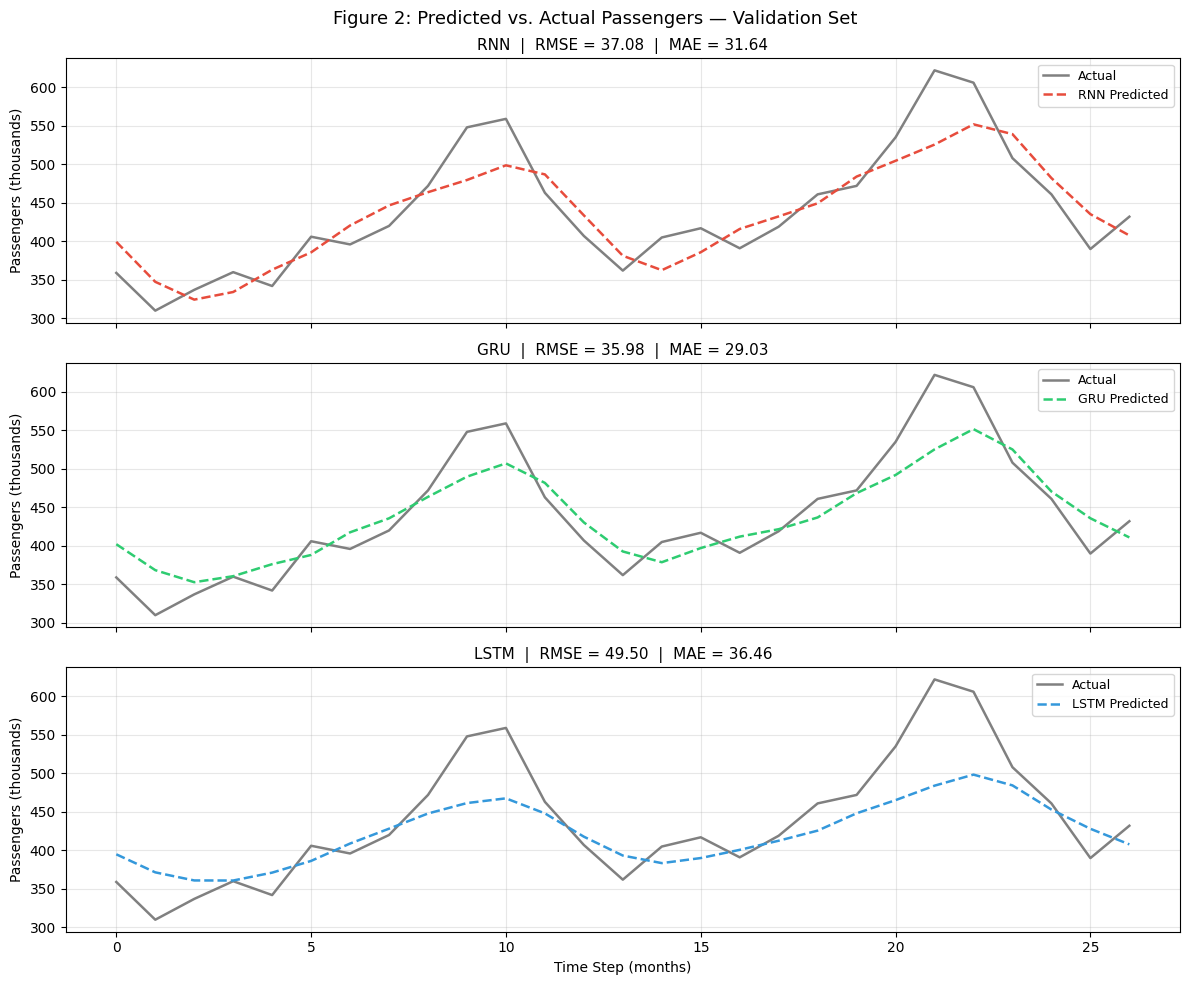
Figure 3: Predictions vs. Actual Passengers — Validation Set (Test 2, lr=0.001)
Hyperparameter Analysis — Learning Rate
| Learning Rate | Test 1 RMSE | Test 1 MAE | Test 2 RMSE | Test 2 MAE |
|---|---|---|---|---|
| 0.0001 | 76.71 | 67.14 | 74.61 | 59.87 |
| 0.001 | 69.64 | 57.61 | 49.50 | 36.46 |
| 0.005 ★ | 46.83 | 39.08 | 33.17 | 27.67 |
| 0.01 | 61.25 | 51.40 | 37.15 | 28.83 |
lr=0.005 + adaptive scheduler achieves the best RMSE of 33.17. The scheduler amplifies the benefit of a correct learning rate while providing robustness against suboptimal choices.
Hyperparameter Analysis — Hidden Size
| Hidden Units | Parameters | Test 1 RMSE | Test 1 MAE | Test 2 RMSE | Test 2 MAE |
|---|---|---|---|---|---|
| 16 | 1,233 | 66.11 | 48.58 | 46.92 | 37.72 |
| 32 | 4,513 | 61.53 | 44.81 | 37.63 | 31.71 |
| 64 ★ | 17,217 | 69.64 | 57.61 | 33.17 | 27.67 |
| 128 | 67,201 | 44.72 | 38.63 | 37.62 | 32.11 |
In Test 2, RMSE improves steadily from 16 to 64 hidden units, then worsens at 128 due to overfitting on just 105 training sequences. 64 units provides the right capacity for this small dataset.
Conclusion
- In Test 1 (baseline), the LSTM performed worst (RMSE=69.64) despite its architectural advantage — a fixed learning rate fails to navigate its complex loss landscape.
- In Test 2 (adaptive scheduler + extended training + checkpointing), the LSTM recovered to RMSE=33.17 — the best result overall and a 52% improvement over its own baseline.
- Architecture alone does not determine performance; a more powerful model requires a training regime capable of exploiting its capacity.
- Optimal configuration: LSTM, lr=0.005, 64 hidden units, 300 epochs, plateau-based LR scheduler.